
Introduction
In today’s fast-paced product development environment, engineers and procurement groups are under tremendous pressure: delivering high-performance end-use products from complex designs within constrained budgets and schedules. One of the biggest and most expensive problems that engineers and procurement groups face is that an initial, seemingly cost-effective outsourcing decisioncan ultimately lead to a project’s demise due to non-conforming products, lead time issues, and communication problems. In most cases, the reason for these problems is not in the design, but in selecting an inappropriate manufacturing partner.
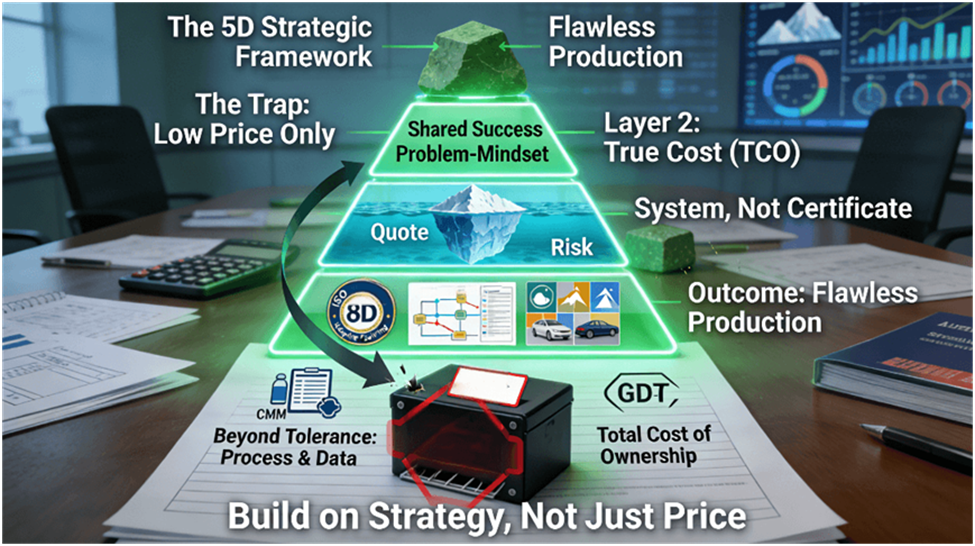
In many cases, suppliers are evaluated on the basis of prices only, while engineering collaboration, process control, and quality culture, which are essentially the core capabilities of suppliers, are ignored. These costs, which are essentially the true foundation of manufacturing, will eventually surface, leading to huge cost and time overruns. This article aims at introducing a strategic evaluation frameworkin five dimensions, enabling teams to go beyond price comparison and truly assess suppliers’ capabilities, avoiding critical mistakes in supplier selection, and making manufacturing an enabling factor in achieving product success.
How to Define “True Precision” in CNC Machining Services?
Precision in manufacturing is a term which signifies far more than just a tolerance on a drawing. In fact, true precision is a complex area that includes not only dimensional accuracy but also surface finish, material homogeneity, and most importantly, consistency of one batch compared to another.The greatest error is to focus only on the tolerance and not to consider the technical support and metrology systemsthat are necessary to actually achieve that tolerance.
1. The Multilayered Meaning of Dimensional Accuracy
Dimensional accuracy is the cornerstone of CNC machining services, but it should be considered as part of a standardized system for it to make any sense. Setting a tolerance of 0. 05mm, for instance, does not provide enough information if one does not also know how to set the datum reference frame and what the geometric controls are. If the component will be assembled with others and the application is of high importance, one should definitely look at the official standards such as ASME Y14.5for Geometric Dimensioning and Tolerancing (GD&T). This standard is recognized to be a language that is universally understood and allows the design intent to be comprehensively communicated without any ambiguity or confusion. As it is highlighted in the ASME Y14. 5 Standard, this is a key factor to making sure that the end product is in accordance with the desired form, fit, and function.
H3: 2. The Critical Role of Surface Finish and Material Integrity
Besides size and shape, precision also involves surface finishwhich can greatly change the functional characteristics such as wear resistance, fatigue, and sealability. It is indeed possible that a part may be dimensionally perfect but still fail in the operation because of an inappropriate surface finish that causes premature wear. In addition, “precision” also means material integrity, i. e. not having internal stresses, tool marks, and thermal effects that may influence the part during operation. A good supplier can control these problems by choosing the best machining parameters, tooling, and coolant strategies.
3. Ensuring Repeatability: The Systems Behind the Spec
The final test of any precision CNC machining service is repeatability. Can they maintain that specification on not only the 1st part but also on the 1,000th part? This depends on how well they have invested in high-end, calibrated equipment, optimal ambient conditions to prevent thermal expansion, and an effective process control system. Their in-house metrology laboratory, equipped with instruments like Coordinate Measuring Machines (CMMs)and optical comparators, is not an indulgence but an absolute necessity to verify their own products and provide documented evidence of conformity.
What Factors Really Determine Your Custom CNC Machining Quote and Pricing?

l Deconstructing the Cost Components: A detailed quote should break down into various cost components. The cost of materials is dependent on whether your product is machined from standard aluminum or from more expensive materials like Titanium or Inconel. The programming time and machine time vary depending on whether your product is machined using a 3-axis machine or a 5-axis simultaneous machine. Other operations like anodizing or heat treatment are important but come at a cost. The most important cost determinant is that of quality assurance; is it included?
l The High Price of “Cheap”: Hidden Costs and Risks: Selecting a business partner based on price only means sacrificing support in the form of engineering support and risk analysis. A good business partner will invest in the quoting process and offer a Design for Manufacturability (DFM)analysis. This process may reveal a design change that greatly simplifies the machining process or eliminates material waste. A “cheap” price does not offer value-added supportand passes all risks back to you.
l Evaluating Quote Transparency and Long-Term Value: Review the transparency of the quote itself. Is it simply a price, or does it offer a “reason why” the price was determined? A good business partner will take the time to inform and educate you on their process. It’s essential to understand the Total Cost of Ownership (TCO), not simply the price itself. While a slightly higher price may be quoted by a business partner with high-tech resources and a process in place, a proven history of on-time delivery of quality parts will always translate to a lower total project cost.
Why Do Quality Certifications Like ISO 9001 Matter Beyond a Badge?
Quality management system certifications such as ISO 9001, IATF 16949 (for automotive), and AS9100D (for aerospace) are commonly considered to be “wall decorations,” or “plaques on a wall.” In reality, these are a demonstration of a quality management systemthat is systematic and verifiable, minimizing risk. These are indicators that a supplier has processes in place that are repeatable and documented for every critical business function, from order review to production control to corrective action to management review.
1. ISO 9001: The Foundation of Process Discipline
ISO 9001 is the fundamental framework for a process-based quality management system. ISO 9001 requires that an organization deliver products and services that meet customer and industry requirements. Most importantly, as described by the International Organization for Standardization, ISO 9001 has a strong focus on continuous improvementthrough data-driven decisions. From your perspective as a customer, every order goes through a predictable and traceable process. There is no chance that your order is being worked on by a skilled machinist who is having a good day.
2. Industry-Specific Certifications: A Deeper Layer of Assurance
ISO 9001 is a very general standard however there are specific standards for various industries that focus on the main problems of that industry. IATF 16949 is a standard made based on ISO 9001 with very strict requirements related to defect prevention, supply chain management, and continuous improvement for the automotive industry. AS9100D has many requirements in common with ISO 9001 but it has very strict requirements related to configuration management, counterfeit part prevention, and risk management for the aerospace industry. When a supplier gets these industry-specific standards, it means that the supplier is considered to be taking measures to the industry-specific risks.
3. Certifications as a Proxy for Cultural Commitment
Fundamentally, a certification serves as a record of an organization’s dedication to the quality culture. It’s a reassurance an organization gives itself and its partners that it has made an effort to create reliable systems and that it will continue to maintain these systems in the future. It is a collective insight and an expectation of quality. When partnering, concentrate on those who have reached the industry standards most appropriate to your sector. A supplier who has met several top tier standards(ISO 9001, IATF 16949, and AS9100D) has a versatile and deeply rooted quality culture that can handle projects ranging from consumer electronics to safety-critical components.
H2: How to Assess a Supplier’s Multi-Industry CNC Machining Applications Expertise?
Having been through different industries is an excellent criterion to check if a potential partner is flexible and has good problem-solving skills. A CNC machinist who has supplied parts for medical devices, aerospace components, automotive parts, as well as consumer electronics, has been through a wide variety of materials tolerances regulatory rules, and failure mode analyses. This type of partner might understand your requirements before you even express them, and draw on their combined experience of several industries in order to meet your project’s specific needs.
1. Beyond Part Galleries: Seeking Depth in Case Studies
When considering the potential for a given partner, it is particularly important to get a deep understanding of their case studies, or in other words, the nature of their work. While it is, indeed, very easy to show examples of images related to the finished parts, a trulyexceptional potential partner, a company with experience in CNC applications in a variety of industries, will be able to offer you effective solutions for your specific needs. If you are interested in gaining a deeper understanding of the specific processes and considerations related to CNC applications in a variety of industries, acomprehensive guide to precision CNC machining services may be beneficial.
2. The Advantage of Cross-Pollinated Innovation
A supplier that caters to a single industry may have a rigid approach. However, a supplier that caters to multiple industries may have the advantage of cross-pollinating innovation. A method that may have been perfected for machining a lightweight yet high-strength component for the aerospace industry may be beautifully adapted to reduce the cost of a component for the consumer electronics industry. Their engineers are trained to think outside the box and apply the best manufacturing expertiseavailable to your specific needs.
3. Evaluating for Your Specific Needs
When evaluating a supplier, you’re after relevance. For instance, in the case you are creating a medical device, to what extent the supplier has a track record of working with biocompatible materialslike titanium and PEEK, and is the supplier familiar with the criticality of surface finishes and cleanliness? And if you are creating a car part, how well does the supplier understand IATF 16949 requirementssuch as the Production Part Approval Process (PPAP)? Talk to them about their past projects and how similar they might be to your specific requirements in terms of materials science, and precision.
What Makes a CNC Machining Supplier a True “Collaborative Partner”?
The last, and perhaps most important, difference is whether a supplier is a “passive order taker” versus a collaborative partner who is actively engaged and works towards a mutual objective of optimizing the entire product development process, rather than just filling a purchase order.
1. Proactive Engineering and DFM Engagement: The tangible indicator that distinguishes a partner is how they reach out to you without being prompted during the design stage. They are not just downloading your CAD file; they are thoroughly analyzing it from a manufacturing standpoint. A genuine collaborative partner will furnish you with unrequested, positive criticism of your design for manufacturing, for instance, by recommending changes such as altering wall thickness for better stability, incorporating radii to reduce stress concentrations, or modifying a feature in a way that eliminates the need for costly 5-axis machining.Take a collaborative partner, for instance, who may help a startup with a complicated part that calls for a major redesign by merely recommending a slight alteration in the draft angleleading to a simpler, more cost-effective mold and ultimately a savings of thousandsin tooling costs.
2. Transparent Communication and Project Management: Effective production is highly dependent on smooth communication and a structured process. A true partner has a well-defined project management processand a single point of contact. This ensures open communication, where the other party is always available to explain and provide updates on the project. They will also be open with you if there are potential delays and offer solutions rather than problems. This helps build trustbetween the two parties and ensures that both are on the same page, avoiding minor issues from becoming major problems.
3. A Mindset of Shared Success and Risk Mitigation: At the core, a true collaborative partner is interested in your success. This is because they are a company whose model is based on long-term relationshipsand repeat business, and not on getting the best return from a single transaction. This is where the two parties are incentivized to work well with each other. A true collaborative partner is interested in helping you avoid costly mistakes, get products to market quickly, and improve the quality of products. This is because they benefit from your success.
H2: Conclusion
The choice of a manufacturing partner for a project is a strategic choice with significant consequences. Going beyond cost as the sole criterion is a necessary step. Indeed, by using the five-dimensional framework proposed above discovering the real meaning of precision, grasping the real cost, valuing quality management systems, benefiting from experience in several industries, and above all, focusing on a genuine partnership you will be able to carry out a successful due diligenceand transform manufacturing from a potential source of risk into a secure and competitive core competency, so that your journey from prototype to production is a success.
FAQs
Q: What is the most common mistake companies make when choosing a CNC machining partner?
A:The most common mistake is focusing almost exclusively on the partner with the lowest initial cost proposal. Indeed, cost is obviously a very important factor, but a very low initial proposal may be a sign that the real cost of a good quality control system, of a good engineering support, and of a good risk avoidance strategy are not taken into account.
Q: How important is a supplier’s capability for in-house quality inspection?
A:It is a non-negotiable requirement for precision work. In-process inspection with tools like on-machine probes enables real-time corrections during production, which is far better than making a batch of parts that are ultimately defective. A supplier with a full complement of metrology lab equipmentlike CMMs and optical comparators shows that they are committed to inspecting their own parts against your specifications. This is far more effective and cost-efficient than final inspection, which only detects defects after all value has been added to the parts.
Q: Can a single manufacturing partner provide a solution that meets both your needs for prototype development and volume production?
A:Yes, and this is a major advantage of a single partner. A partner that is proficient at both prototype development and volume production means that design intent from the prototype phase is directly transferred into production. This eliminates potential knowledge lossthat could occur if a separate prototype house and a separate volume production house are utilized.
Q: What is the difference between “standard” and “precision” CNC Machining services?
A:The difference is determined by tolerance requirements, and the overall control and technology infrastructure. “Standard” refers to the production of non-mission critical parts where the tolerances are relatively loose (tolerances of 0.1mm or larger). Precision, on the other hand, involves the use of top-of-the-line equipment, climate-controlled environments, and advanced process monitoring to be able to consistently achieve very tight tolerances (tolerances as small as 0.025mm or smaller) and fine surface finishes. Precision Machining is an exacting science, not simply an art of shape-making.
Q: How long before your product design is finalized should you bring your manufacturing partner into the process?
A:Ideally, the earlier the better. The best outcome is to include your manufacturing partner when you are at the conceptual or detailed design stage of your product. Then, your manufacturing partner’s engineers can carry out a thorough Design for Manufacturability (DFM) studyof your product to discover design modifications that could enhance cost profile reliability performance, and assembly efficiency of your product without changing its functional integrity.
