
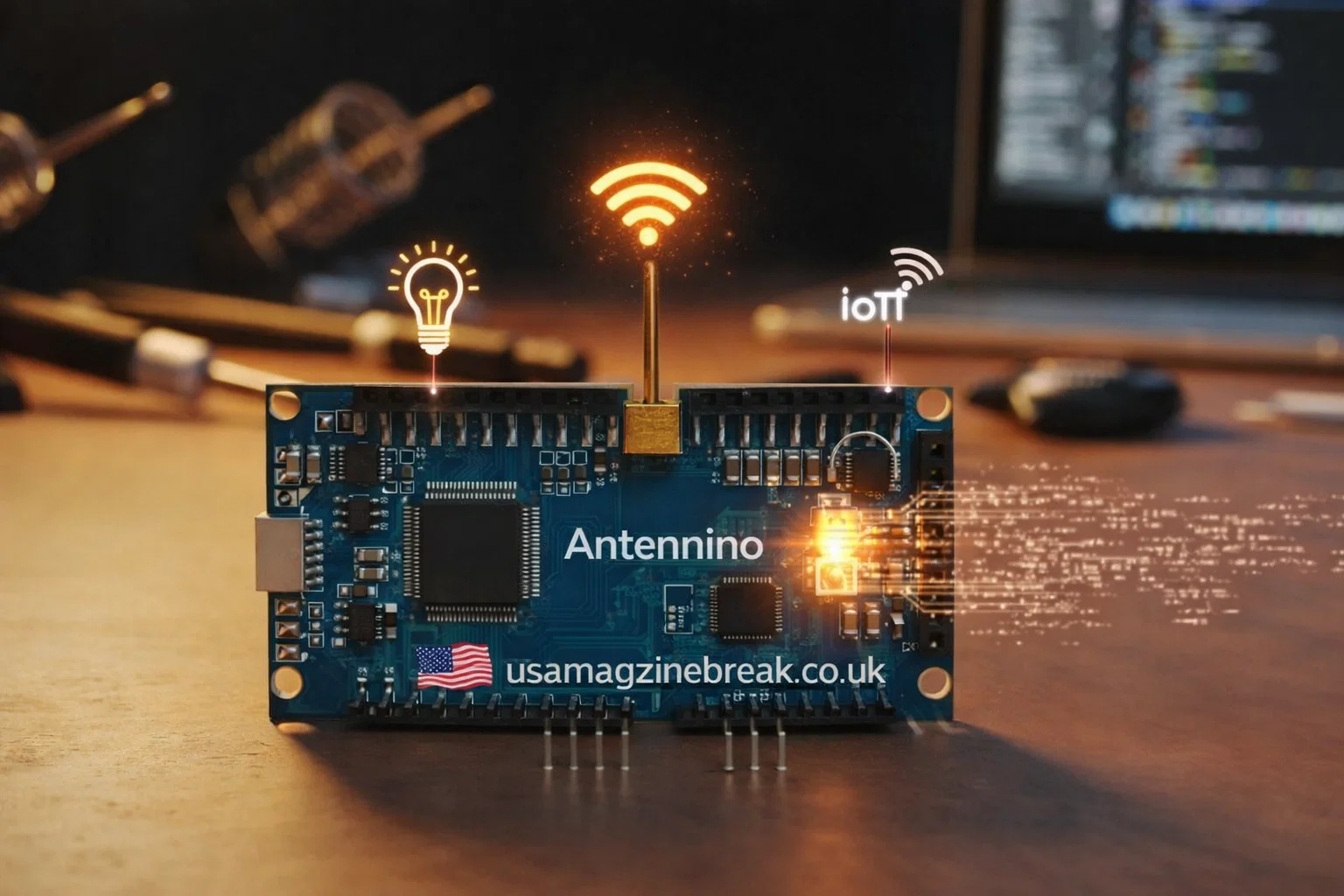
Introduction to Antennino and IoT
Antennino is a highly versatile wireless board specifically designed for IoT (Internet of Things) projects. It provides an easy-to-use solution for building wireless sensor networks, remote monitoring systems, smart home devices, and other embedded systems. By integrating a compact and efficient design with an Arduino compatible board architecture, Antennino offers a user-friendly experience for both beginners and professionals. It brings together reliable wireless communication with low power consumption, making it suitable for projects that require battery powered sensors or long-term deployment in remote areas. The board leverages the RFM69 radio module and sub GHz wireless transceiver technology to ensure long range data transmission and signal stability, which is essential for IoT applications such as smart agriculture sensors, environmental monitoring systems, or robotics connectivity. Its ability to support OTA (over the air) updates and wireless telemetry adds flexibility and convenience, allowing users to maintain and scale projects without constant manual intervention. Antennino has rapidly become a favorite in the maker community and educational IoT projects because it combines open source hardware support with practical features needed for prototyping and rapid development.
Core Components of Antennino
The core of Antennino is a low power microcontroller, most commonly the ATmega328P, which provides the foundation for microcontroller development and embedded systems. This microcontroller is optimized for energy efficiency, ensuring that applications like battery powered sensors or remote monitoring systems can operate for extended periods without frequent maintenance. The RFM69 radio module integrated into the board functions as a sub GHz wireless transceiver, enabling robust RF communication over long distances while reducing interference and optimizing signal strength. Additional interfaces, including SPI and I²C, allow for seamless sensor interfacing and analog/digital I/O integration. This makes Antennino highly adaptable for various IoT projects, whether it is a single sensor node for environmental monitoring or a complex network of devices forming a wireless mesh network. The board’s compact wireless board design and low power consumption make it highly portable and suitable for deployment in constrained spaces or remote outdoor environments. The integration of a directional antenna further enhances wireless performance, ensuring reliable signal transmission across different IoT system configurations.
How Wireless Communication Works in Antennino
Antennino relies on sub GHz wireless communication to deliver reliable connectivity between sensor nodes, gateways, and central controllers. This frequency range allows for longer transmission distances and better penetration through obstacles compared to higher frequency bands, making it ideal for IoT deployments in homes, farms, and industrial environments. The board supports mesh networking, allowing multiple devices to communicate seamlessly and maintain network reliability even if one node fails. This wireless mesh network topology ensures efficient data routing and scalability, supporting complex deployments such as smart city infrastructure or large-scale environmental monitoring systems. Signal strength optimization can be achieved through proper antenna integration and monitoring of RSSI (Received Signal Strength Indicator) values. These features allow Antennino to maintain wireless reliability and provide consistent performance across a wide range of IoT applications.
Setting Up Your Arduino Compatible Board
Getting started with Antennino is straightforward due to its Arduino compatible board design. Users connect the board to a computer using USB and program it via the Arduino IDE. Arduino style sketches provide a familiar interface for creating and deploying code for various IoT projects. The board supports sensor interfacing, wireless telemetry, and OTA programming, making remote firmware updates and network adjustments convenient. Users can configure sensor nodes for data logging and monitoring, ensuring that data is collected and transmitted reliably. This setup is particularly beneficial for low power IoT devices, where long battery life is critical, and constant maintenance is challenging. Whether it is a smart home automation project, an environmental monitoring setup, or an educational IoT project, the Arduino compatible design allows for rapid prototyping and easy integration of additional modules.
Power Efficiency and Low Power IoT Device Features
One of the defining features of Antennino is its focus on power efficiency. The board is designed to operate with minimal energy consumption, making it ideal for battery powered sensors deployed in remote locations or smart home devices that need to function continuously. Its low power microcontroller and optimized energy efficient design allow it to sustain long battery life while performing wireless communication and telemetry tasks. This makes it well suited for IoT projects that require minimal intervention, such as environmental monitoring of air quality or soil conditions, smart agriculture sensors for irrigation control, or robotics connectivity for autonomous devices. The board’s OTA updates and support for low data rate applications ensure that software maintenance is straightforward without compromising battery performance. By combining low power consumption with long-term reliability, Antennino provides a practical and sustainable solution for diverse IoT deployments.
Antennino in Smart Home Devices
Smart home automation benefits significantly from Antennino’s capabilities. Its wireless automation support allows devices such as lights, thermostats, and security sensors to communicate efficiently over long distances. Directional antenna integration and signal optimization ensure consistent performance across rooms or large buildings. Wireless telemetry allows homeowners to receive real-time updates about their devices, enabling them to monitor energy usage, security status, or environmental conditions remotely. The board’s embedded communication stack ensures reliable connectivity between devices, while the compact wireless board design makes installation and integration simple. With Antennino, smart home devices can operate seamlessly, providing convenience, energy savings, and improved control over home environments.
Antennino for Environmental Monitoring
Environmental monitoring is an area where Antennino excels due to its support for multiple wireless sensor nodes and long-range communication. The board can collect data from sensors measuring temperature, humidity, air quality, or soil conditions and transmit it to a central monitoring station through a wireless gateway. Its RF module integration and mesh networking support ensure data reliability and reduce interference from other devices. Antennino’s low power consumption and compact design make it suitable for remote deployment in natural environments, urban areas, or industrial zones. By using Antennino for environmental monitoring, organizations and individuals can make data-driven decisions for sustainability, safety, and resource management.
Smart Agriculture Sensors and IoT Projects
Antennino plays a critical role in modern agriculture by enabling real-time monitoring and control of environmental factors affecting crop growth. Smart agriculture sensors connected to Antennino can track soil moisture, temperature, humidity, and other relevant metrics, providing actionable data to farmers. The board’s long battery life and low power microcontroller allow sensor nodes to function for extended periods without human intervention. Mesh networking allows multiple sensor nodes to communicate effectively, ensuring that data reaches central systems even in large fields. The board’s compact wireless board design and sub GHz wireless transceiver ensure robust performance in outdoor and remote conditions. Farmers can leverage this technology to optimize irrigation, prevent crop damage, and increase productivity through data-driven insights.
Robotics Connectivity and Remote Monitoring
Robotics projects benefit from Antennino’s wireless connectivity and mesh networking capabilities. The board allows autonomous robots, drones, and other mobile devices to communicate reliably with base stations or other nodes in the network. Its sub GHz wireless transceiver ensures long range data transmission while reducing interference, and OTA programming allows remote firmware updates for ongoing optimization. Antennino supports embedded communication stacks and sensor interfacing, enabling robots to collect and process environmental data in real-time. Its low power IoT device design ensures that even battery-powered mobile devices can operate efficiently for extended periods. Robotics connectivity powered by Antennino opens opportunities for research, industrial applications, and educational projects focused on automation and remote monitoring.
Educational IoT Projects
Antennino is widely used in educational settings to teach students about IoT, embedded systems, and wireless sensor networks. The Arduino compatible board allows learners to experiment with programming, prototyping, and network design through hands-on projects. Students can explore mesh networking, RF communication, and sensor interfacing in a practical environment. Open source hardware support and Arduino style sketches provide an accessible entry point for beginners while offering advanced customization for experienced users. Educational IoT projects using Antennino encourage problem-solving, innovation, and understanding of network scalability, energy efficient design, and data logging techniques. It is a practical platform for introducing learners to the real-world applications of wireless IoT system design.
Practical Tips for Signal Optimization
Achieving optimal performance with Antennino requires attention to wireless configuration and network design. Proper directional antenna placement reduces interference and enhances signal strength. Monitoring RSSI values helps ensure consistent connectivity across sensor nodes and wireless gateways. Mesh networking allows nodes to maintain communication even if individual devices fail, enhancing reliability and scalability. Efficient placement of sensor nodes, combined with low power consumption and compact wireless board design, ensures long battery life and minimal maintenance. Signal optimization strategies are particularly important in large-scale smart city infrastructure, environmental monitoring, and smart agriculture deployments where reliable data transmission is critical for system performance.
Integration with Other IoT Devices
Antennino can seamlessly integrate with other IoT devices to form complex systems. Smart home devices, environmental sensors, smart agriculture sensors, and robotics can all be connected through wireless gateways using Antennino boards. Its compatibility with Arduino IDE programming, open source community support, and flexible communication protocol support allow for rapid prototyping and reliable operation. Multiple sensor nodes can be configured to log data and communicate through mesh networking, enabling effective monitoring and control. Gateway node configuration ensures that data collected from Antennino boards is transmitted efficiently to central systems, making it suitable for educational, industrial, and commercial IoT deployments.
Advantages of Open Source Hardware
Open source hardware support is one of Antennino’s key advantages. The maker community provides extensive resources, tutorials, and examples for Arduino IDE programming and RF module integration. Open source designs allow users to modify the board, experiment with new configurations, and contribute to ongoing improvements in IoT system design. Educational IoT projects benefit from open source hardware by providing a platform for learning and experimentation, while professional deployments leverage the flexibility and adaptability of Antennino in industrial or research applications. Open source community support encourages collaboration and innovation, making Antennino an ideal choice for both learning and professional projects.
Challenges and Limitations
Despite its many benefits, Antennino has some limitations. It is optimized for low data rate applications and may not be suitable for high-bandwidth needs such as video streaming. The sub GHz wireless transceiver, while reliable, may encounter challenges in densely built environments or areas with significant RF interference. Large-scale deployments require careful mesh networking design and network scalability planning to maintain reliable communication. Users must consider these factors when designing IoT projects to ensure that Antennino can meet performance expectations in specific applications. Understanding these limitations helps users plan deployments effectively, optimizing both hardware and network configurations for long-term success.
Conclusion
Antennino is a powerful and versatile solution for IoT wireless projects. Its combination of low power microcontroller design, sub GHz wireless transceiver, mesh networking capabilities, and Arduino compatible board architecture makes it suitable for smart home devices, environmental monitoring, smart agriculture sensors, and robotics connectivity. With OTA programming, battery powered sensors, and open source hardware support, Antennino enables rapid prototyping, efficient deployment, and reliable long-term operation. Educational projects, DIY electronics, and professional IoT deployments all benefit from its flexibility and performance. By integrating Antennino into IoT projects, users can leverage wireless automation, remote monitoring, and sensor interfacing to create innovative and scalable solutions for modern technology challenges.
FAQs about Antennino
Q1: What is Antennino used for?
Antennino is used for IoT projects, smart home devices, environmental monitoring, robotics connectivity, and educational projects.
Q2: Is Antennino compatible with Arduino IDE?
Yes, it is fully Arduino compatible and supports Arduino style sketches for easy programming.
Q3: Can Antennino work in low power applications?
Yes, it is designed as a low power IoT device with long battery life suitable for remote monitoring.
Q4: Does Antennino support mesh networking?
Yes, multiple Antennino boards can form a wireless mesh network topology for reliable communication.
Q5: Can it be used in smart agriculture projects?
Absolutely, Antennino can connect to soil sensors, crop monitoring devices, and other remote IoT deployments.
